
How Your Environment Can Support Mental Health Changes

You can understand a pattern clearly and still feel it return when you step back into the same routine. The desk, the noise outside, the light in the room, and the path you take each morning can become part of how a day unfolds.
Thoughts, behavior, relationships, health, and surroundings can all influence how a person feels. The useful question is whether changing a few environmental cues makes it easier to practice the changes you are already working on.
Topics
Your Surroundings Can Become Memory Cues
The background environment can serve as a cue for memory retrieval. A neuroscience review (opens in a new tab) identifies the hippocampus, retrosplenial cortex, and anterior thalamus as key parts of a circuit that represents contextual information and supports context-dependent retrieval.
This helps explain why a familiar place can bring a memory to mind quickly. It does not mean that every difficult feeling is stored in a room or that returning to a place automatically recreates an emotional state.
A review and meta-analysis found (opens in a new tab) reliable environmental context-dependent memory effects across studies, although the effects were reduced when other cues were available or when people mentally reinstated the original context.
In ordinary life, this means a location may be one cue among many. A home office can remind you of a stressful deadline. A particular chair may be associated with difficult conversations. These examples are practical possibilities, not universal clinical mechanisms.
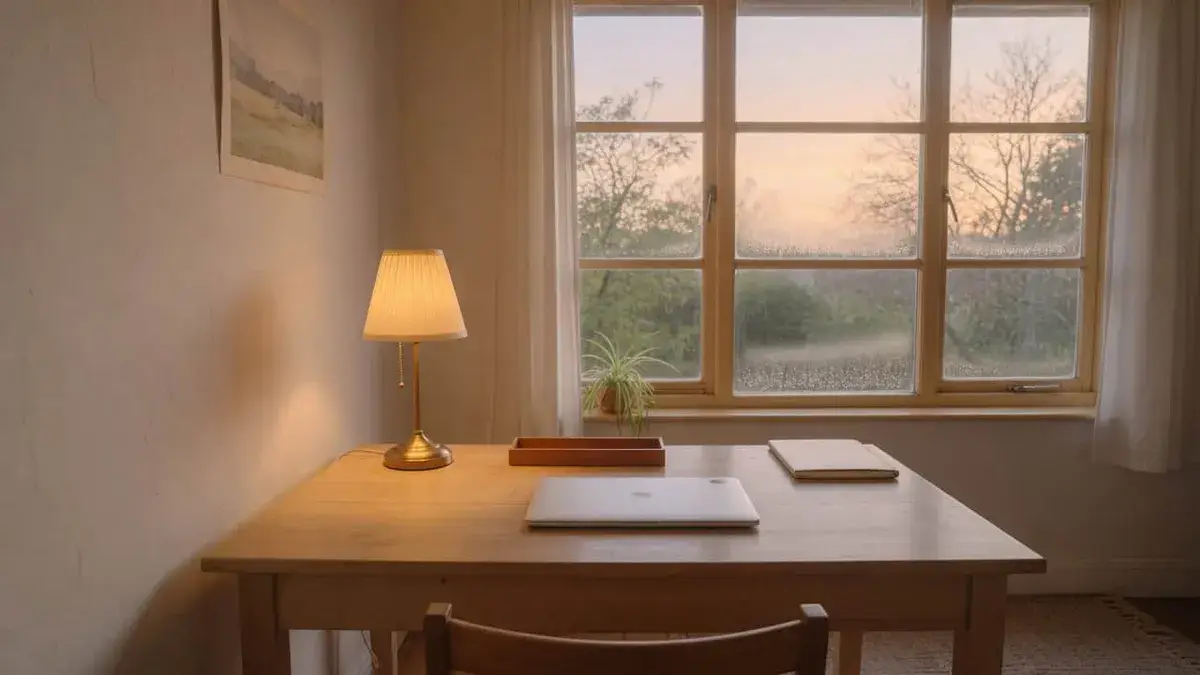
Noise and Light Can Affect Daily Functioning
Environmental noise can disturb sleep and interfere with work or school performance. WHO’s noise guidance (opens in a new tab) describes these effects; it does not establish that every distracting sound causes illness.
Persistent noise deserves attention when it repeatedly interrupts something you need to do. A quieter room may remove one obstacle while other contributors to anxiety or poor sleep remain.
Light is an important signal for the circadian system. A review reports that nighttime light can alter human circadian rhythms and sleep, while appropriately timed light can be used therapeutically to support sleep and mood. [8] (opens in a new tab)
Timing and intensity matter. Practical changes can include reducing bright light late at night, seeking daylight earlier in the day, or discussing persistent sleep problems with a qualified professional.
What hospital room studies can and cannot tell us
In a matched observational study (opens in a new tab) of 46 surgical patients, those assigned to rooms with windows facing a natural scene had shorter postoperative stays and used fewer potent analgesics than patients in similar rooms whose windows faced a brick wall.
That study is interesting, but it does not prove that a view alone caused every outcome. It supports careful study of how surroundings may contribute to recovery alongside medical care, staffing, treatment, and individual differences.
What changing location can and cannot do
Research on environmental context-dependent (opens in a new tab) memory suggests that features of the surrounding context can become retrieval cues. Changing location may change some cues, but does not by itself establish that symptoms or relationship difficulties will change.
Moving apartments, changing offices, or buying new furniture cannot substitute for addressing depression, trauma, anxiety, conflict, or unsafe circumstances. People can also recreate familiar routines in a new place. A useful environmental change is specific and connected to a behavior you want to support.
Behavioral activation is a structured treatment that helps people increase engagement with meaningful or potentially rewarding activities. Research (opens in a new tab) on that treatment should be distinguished from research on changing a room.
Environmental planning can make an agreed activity easier to begin and repeat. It remains one part of a treatment plan.
Looking For Therapy?
Start Here.
Be Careful With Claims About Unconscious Cues
People do not consciously notice every cue affecting attention or perception. Broad claims that unconscious surroundings determine emotion go beyond what the cited critical review (opens in a new tab) establishes.
If a room feels uncomfortable, start with what you can observe. Is it loud? Too bright at night? Hard to use for its intended purpose? Associated with a repeated conflict? Concrete observations are more useful than assuming the room is secretly controlling your nervous system.

Practical Environmental Experiments
Changes to surroundings may be worth testing as practical supports, but research does not show that small environmental modifications are generally more effective than cognitive therapy. A systematic review of controlled built-environment interventions found the overall evidence (opens in a new tab) for effects on mental health and quality of life was weak.
Try one reversible change, connect it to a specific goal and notice what happens. For example, you want to read after dinner but the book stays inside a bag beside work materials. You spend the evening answering messages instead. Putting the book beside the chair you use after dinner may make starting easier; it also lets you see whether the main obstacle was access, work demands, low energy or something else.
- Reduce a recurring source of noise during sleep or focused work.
- Use a different location for a task that has become difficult to start.
- Put the materials for a valued activity where they are easy to reach.
- Change the seating arrangement used during difficult conversations.
- Adjust evening light to support a more consistent sleep routine.
- Create a visible boundary between work and rest in a shared room.
Choose one change at a time. Compare whether you began the intended activity, what interrupted it, and whether it remained worth doing. If starting becomes easier, consider keeping the arrangement for the next similar evening. If nothing changes, you can reverse it and discuss the obstacle rather than treating the result as a judgment about yourself.
How Therapy Can Use Environmental Information
A therapist may ask where symptoms are strongest, what happens before they intensify, and which routines make coping easier or harder. That information can support approaches such as cognitive behavioral therapy, behavioral activation, mindfulness, or practical problem-solving.
Environmental changes can form part of a broader plan for sleep, attention, movement, connection and practice between sessions. They cannot make an unsafe relationship safe, remove a medical cause or replace treatment when it is needed.
Manhattan Mental Health Counseling provides psychotherapy by secure live video for clients physically located in New York State during sessions. A therapist can help examine where an activity becomes difficult, agree on a manageable change and review what happened.
Frequently Asked Questions
Can your surroundings affect how you feel?
Thoughts, behavior, relationships, health, and surroundings can all influence how a person feels. The useful question is whether changing a few environmental cues makes it easier to practice the changes you are already working on.
Can changing your environment replace therapy?
Moving apartments, changing offices, or buying new furniture cannot substitute for addressing depression, trauma, anxiety, conflict, or unsafe circumstances. Environmental planning can make an agreed activity easier to begin and repeat. It remains one part of a treatment plan.
How can I test an environmental change?
Try one reversible change, connect it to a specific goal and notice what happens. Choose one change at a time. Compare whether you began the intended activity, what interrupted it, and whether it remained worth doing.
Looking For Therapy?
Start Here.
Related reading
Sources
| Source | What it covers |
|---|---|
| 1. Miller and colleagues The limbic memory circuit and the neural basis of contextual memory (opens in a new tab) | Identifies the hippocampus, retrosplenial cortex and anterior thalamus as key parts of a circuit that supports context-dependent memory retrieval. |
| 2. Smith and Vela Environmental context dependent memory a review and meta analysis (opens in a new tab) | Found reliable environmental context-dependent memory effects across studies. |
| 3. WHO Regional Office for Europe Noise (opens in a new tab) | Describes how environmental noise can disturb sleep and interfere with work or school performance. |
| 4. Ulrich View through a window may influence recovery from surgery (opens in a new tab) | A matched observational study of 46 surgical patients whose windows faced a natural scene or a brick wall. |
| 5. Dimidjian and colleagues Randomized trial of behavioral activation cognitive therapy and antidepressant medication (opens in a new tab) | A randomized trial of behavioral activation, cognitive therapy and antidepressant medication. |
| 6. Newell and Shanks Unconscious influences on decision making a critical review (opens in a new tab) | A critical review of claims about unconscious influences on decision making. |
| 7. Moore and colleagues Effects of changes to the built environment on adult mental health and quality of life (opens in a new tab) | Found that the overall evidence for built-environment effects on mental health and quality of life was weak. |
| 8. Blume Garbazza and Spitschan Effects of light on human circadian rhythms sleep and mood (opens in a new tab) | Reports that nighttime light can alter circadian rhythms and sleep, and that timed light can support sleep and mood. |
This article is for informational purposes and is not medical advice.
Start Therapy Now or call 212‑960‑8626 to arrange a free 15-minute screening call.
