


When people say the research supports online therapy for anxiety, they are usually citing studies of something else. Most of that evidence comes from structured online CBT programs. These are software-based courses that a person completes. A clinician checks in during the program. A 53-minute live video session with a therapist is a different product. The two are treated as one, and that confusion matters. It hides the real question. Which parts of CBT are essential? And do those parts work over a video connection? They do, and knowing why tells you whether this format will work for you.
What CBT is actually doing when it works
CBT works through two objects, a written record of a prediction and a planned action that tests it.
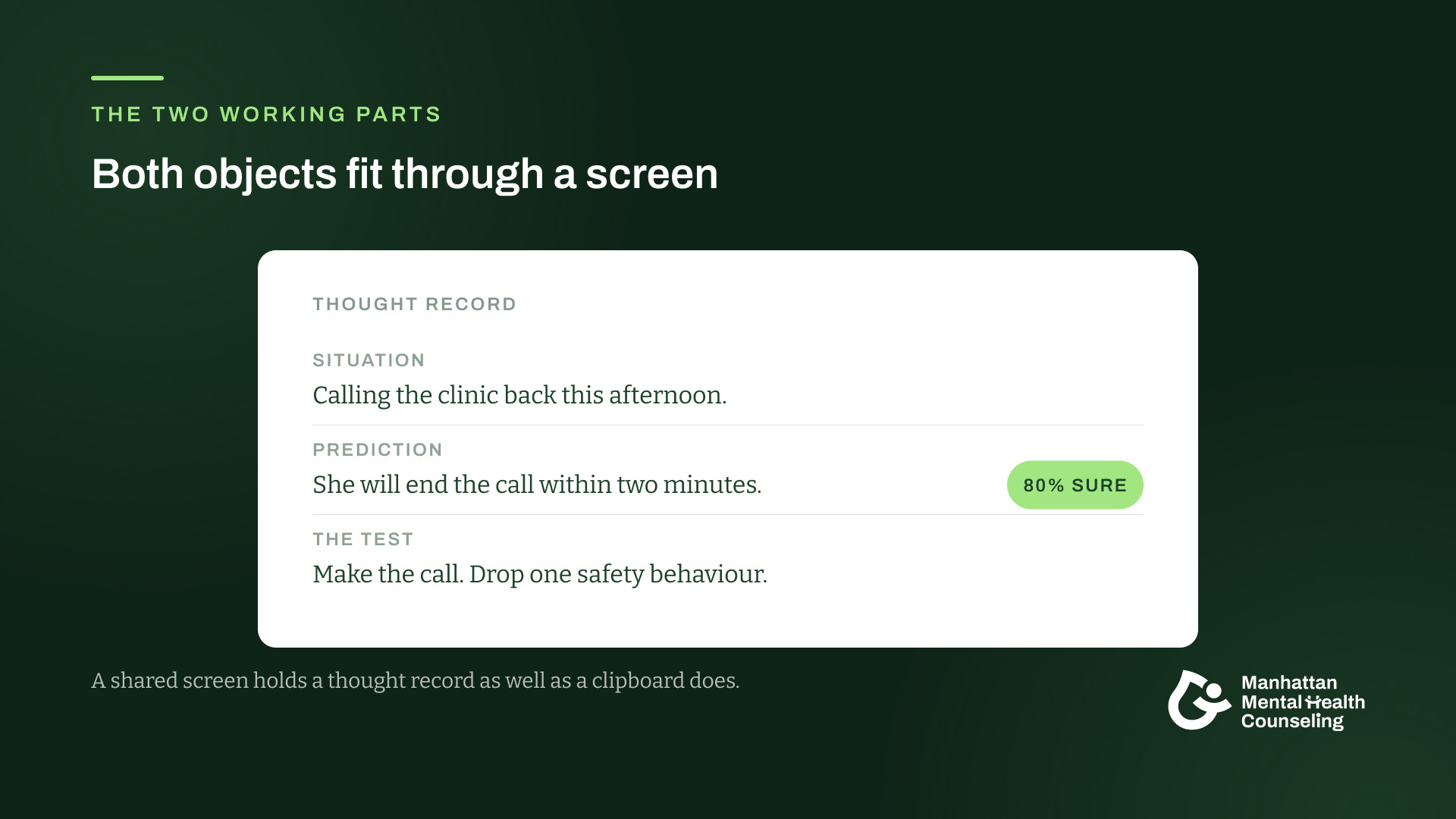
The record is the part most people skip. You name the situation, write the automatic prediction, and mark how certain it feels. Then you separate what you can establish from what you assumed. The clinician’s job at that stage is to stop you settling for a conclusion that is merely familiar.
The action is where anxiety actually changes. A behavioral experiment creates a clear test. Prepare for one hard conversation. Enter one social situation without seeking reassurance. Or delay avoidance long enough to see what happens. You come back with data neither of you had before the session.
Both objects are portable. A shared screen holds a thought record as well as a clipboard does, and the test happens in your week, not in the room. The room was never doing the work.
What the research supports, and what it does not
Remote CBT for social anxiety has been measured directly, and the finding is specific rather than sweeping.
A 2021 systematic review and meta-analysis in Clinical Psychology and Psychotherapy pooled 20 randomised controlled trials covering 1,743 participants. Internet-based CBT had a significant positive effect on social anxiety disorder versus control groups. A subgroup analysis found internet CBT and face-to-face CBT worked equally well. That is a real result, and it is a result about internet CBT programs. It supports the claim that structured CBT keeps working when it is delivered remotely. It does not measure video sessions specifically, and it says nothing about any individual reader’s outcome.
For video specifically, a 2022 rapid review in Military Medicine compared behavioral health treatments delivered in person against telehealth. It reported similar outcomes overall. It also found that, in two studies, people with more severe symptoms did worse on telehealth. This included people with anxiety disorders. In-person participants with similar severity did better. That limitation belongs in the same breath as the headline. Severity is a reason to raise the format question with a clinician rather than assume the answer. The review searched only one database and used data from a military health group. So, it is a signal, not a settled matter.
Taken together, online CBT therapy by a clinician over video has strong support. That said, the honest claim has some limits.
Why the commute is a clinical variable, not a convenience
Attendance is the main factor in whether a CBT course is completed. A Midtown commute can make it hard to attend each week.
CBT is dose-dependent in a plain sense. The record gets built session by session, and the experiments only accumulate evidence if they keep happening. A format that adds forty minutes of travel to each appointment is not neutral about whether week nine happens. Removing the trip changes the arithmetic of showing up, which is a clinical effect arriving through a logistical door.
The environment on your end takes over some of what the office used to supply. A room with a door, a connection that holds, and a phone left in another room give the session enough structure. That is a smaller ask than it sounds, and it is a real one.
The skill for the part where you stall
Certainty arrives after the test, not before it.
Anxiety does not usually stop you from knowing what to do. It stops you from doing it without a guarantee first. The rule under that is this: If I go in without being sure, what happens will be too much to recover from. Every hour of rehearsal is that rule being obeyed.
Begin by naming the job you have taken on, in the present tense: “I am trying to be certain before I move.” Naming the activity separates it from preparation, which is what makes it possible to put down.
Then write the prediction as one testable sentence, with a number attached. Not “it will go badly” but “she will end the call within two minutes, and I am eighty percent sure.” Vague predictions cannot fail, which is how they survive for years.
The next question has a yes or no answer. Answer it with facts, not feelings. Is there anything I could learn that would settle this before I act? Usually there is not, and hearing yourself say so is the point.
If you want to test it, undersize the test. Pick the smallest action that still puts the prediction at risk, and drop exactly one safety behaviour rather than all of them. Twenty minutes, one dropped behaviour, then stop. Total interventions get refused by the system that built the rule.
Naming what that costs matters here. Going in without rehearsal or reassurance can feel like walking in unarmed. Safety behavior is why the prediction has never been tested in real life.
You keep the option to reinstate it. Nothing has been surrendered permanently, and you can put the safety behaviour back next week if you want to. The aim in all of this is a tested prediction rather than a calmer body.
One limit worth stating. This works when the risk you are predicting is larger than the risk that exists. If the situation has a real cost you expect, you have a clear reason to prepare. If stopping your preparation would cause real trouble, your prediction is helping. Bring the situation to the session, not the rehearsal. The same goes if you are in the middle of a panic episode. The useful move is to get through it, not to run a test during it.
When social anxiety changes the calculation
Social anxiety makes the format choice harder than general anxiety does.It deserves its own answer. Video removes an exposure some clients need. Walking into a room and being looked at is the feared situation. A client who only meets their therapist on a screen may be avoiding a part of it. A clinician using social anxiety therapy handles this by shifting exposure to the week. This fits where CBT was always going to place it. The session plans the test; the reader runs it in a real room.
That is a live clinical judgment rather than a settled rule, and it belongs in the first few sessions.
How to find out whether this fits you
A free 15-minute screening call is the first step, and it exists to answer exactly this question rather than to enrol you.
MMHC provides psychotherapy for anxiety entirely by secure live video for clients located in New York State. Every session is a live video visit with a New York-based therapist. Sessions last 53 minutes. Evening and weekend times are available. MMHC’s Therapy Coordinator matches you with a therapist; if the fit is wrong, you can be rematched. The first therapy session is often available within five days.
MMHC is in-network with Healthfirst, Aetna, Cigna, and UnitedHealthcare among other carriers listed on the insurance page. MMHC verifies your benefits before your first session and tells you what you will pay. The harder part is usually finding a CBT therapist. They need to take your insurance and have an open time slot. Most attempts to start therapy stall after the third or fourth call. MMHC’s Therapy Coordinator does this for you. They take what you share on the screening call. They match you with clinicians who have the right training. They also accept your insurance. They check availability based on your schedule.
If you want a clear answer, not more research, see an anxiety therapist in New York. In two sessions, they can explain what a month of reading may not.
Start Therapy Now at https://manhattanmentalhealthcounseling.com/contact/ or call 212-960-8626.